
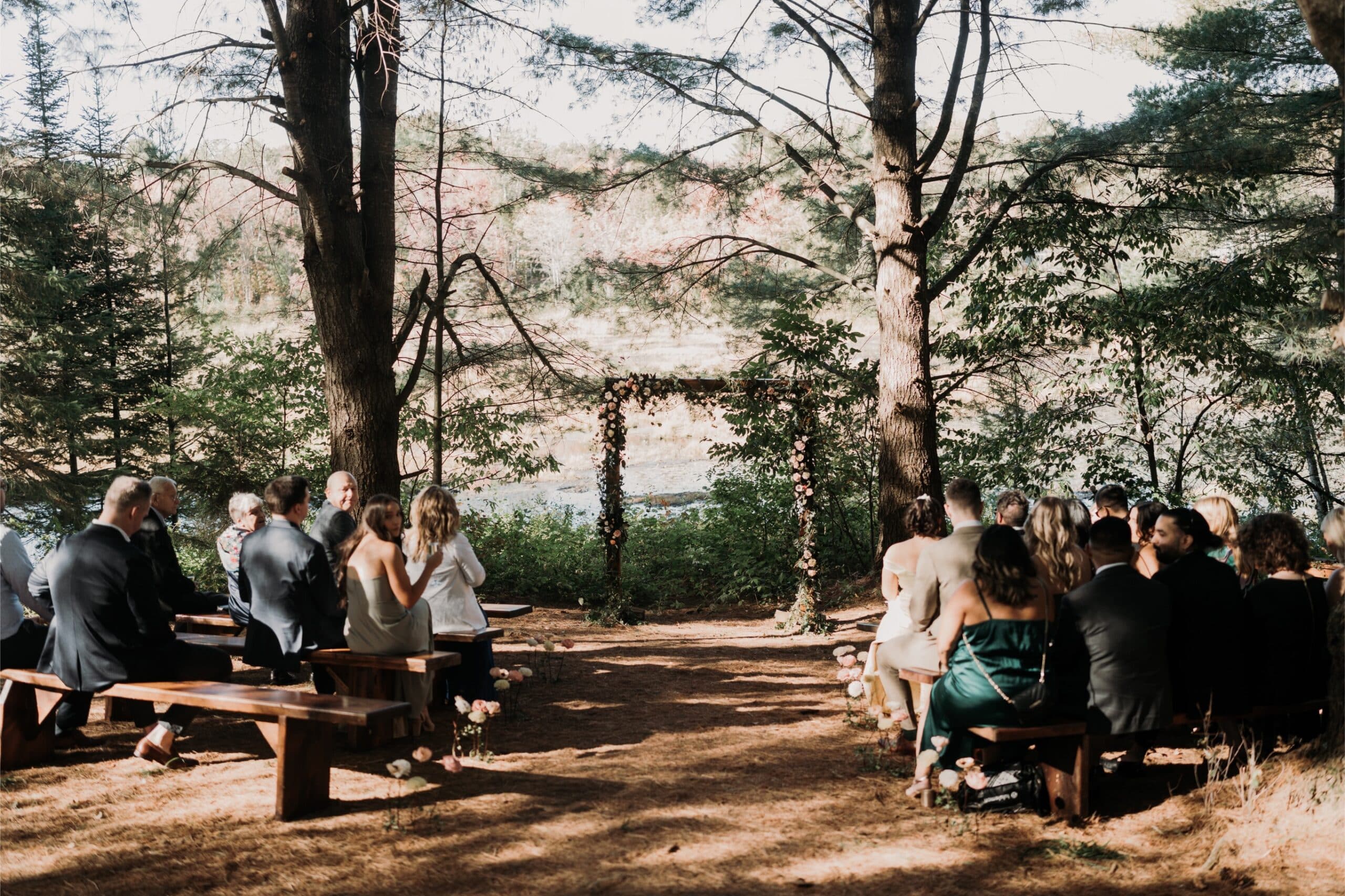
Most couples don’t spend much time thinking about ceremony seating until they’re deep into planning and someone asks the question. Chairs or benches? And then they realize they’ve never actually thought about it, they’ve just assumed chairs because that’s what weddings have always had, the same white resin folding chairs at every outdoor ceremony they’ve ever attended.
That assumption is worth examining, especially if you’re getting married outside. The seating your guests sit on for your ceremony is visible in every single photo from that day. It shapes the physical experience of the people watching you exchange vows. It interacts with your terrain, your aesthetic, and your venue in ways that matter more than most couples realize until they see the photos afterward and notice that the seating either belonged there or it didn’t.
So here’s the honest answer to the benches vs. chairs question, which is that it depends, but the factors it depends on almost always point in the same direction for outdoor ceremonies.
Why This Decision Matters More Than It Seems
Ceremony seating is a background element in the sense that guests aren’t focused on it. They’re focused on you. But background elements are what create the visual and emotional context for everything happening in the foreground, and that context shows up in every image your photographer captures.
Think about the ceremony photos you’ve seen that stopped you. The ones where the setting felt completely cohesive, where the aisle and the seating and the backdrop all worked together as a single image rather than a collection of separate components. That cohesion doesn’t happen by accident. It happens when every element in the frame belongs there, and seating is one of the largest elements in the frame.
There’s also the guest experience dimension. Your guests are going to sit in their ceremony seats for 20 to 30 minutes, watching the most important moment of your day. How they’re seated, how close they are to the people beside them, how stable and comfortable the seating feels, all of that shapes whether they’re fully present and emotionally open or slightly distracted by a chair that’s sinking into the grass.
The Case for Chairs
Chairs have real advantages, and it’s worth being honest about them before making the case for benches.
Individual chairs are widely available and easy to source from almost any rental company. They’re familiar to guests and require no explanation or adjustment. They give each person their own defined space, which some guests genuinely prefer, particularly those who are older or who have mobility considerations. Chairs with arms provide support that benches don’t, and for guests who have difficulty standing from a low seat, an armrest makes a meaningful difference.
On a flat, well-maintained surface, standard folding chairs also set up quickly and create clean, even rows without much additional work.
The limitations show up when you move outside, and they show up in a few specific ways. Standard folding chairs are not designed for uneven terrain. On sloped grass, they tip forward or back depending on which way the grade runs. On soft ground, the legs sink at different rates, which means rows that start level become uneven as the day goes on and guests shift their weight. On sand or gravel, the legs don’t find purchase the way a wider-footed bench does. On granite or stone, they slide.
White resin folding chairs are also a visual mismatch for most natural outdoor settings. Against a backdrop of birch trees, a granite outcropping, and a lake, a row of white plastic chairs reads as an intrusion rather than part of the scene. That’s not a dealbreaker for everyone, but it’s worth knowing going in.
Did You Know? The standard white resin folding chair weighs roughly 9 to 10 pounds and sits on four small-diameter legs. On soft ground or grass, each leg exerts significant pressure on a small contact area, which is why they sink and tilt over the course of an outdoor event. A wooden bench distributes weight across a much larger footprint, which is why it stays level on surfaces where chairs don’t.
The Case for Benches
Wooden benches built for outdoor use solve most of the problems that chairs create in outdoor settings, and they introduce a different set of qualities that work very well for ceremonies specifically.
The terrain advantage is significant. A well-built outdoor bench sits on a wider, more stable base than a folding chair. At Wedding Benches of Muskoka, every bench is leveled individually to the best of our ability, on whatever surface the venue presents, whether that’s a flat lawn, a slope toward the water, a section of uneven grass, or a mixed terrain property where the ceremony site transitions between surfaces.
The communal dynamic of bench seating also does something to the energy of a ceremony that individual chairs don’t. When guests sit side by side on benches rather than in separate chairs, they’re physically closer to the people beside them. Families lean into each other. Friends share the moment in a way that feels more connected than a row of separate seats allows. That proximity creates a warmth in the ceremony atmosphere that’s genuinely different from the more formal arrangement of individual chairs.
Then there’s the aesthetic dimension. Warm wood tones against a natural outdoor setting look like they belong there. The grain of the wood picks up the light. The material fits the environment. When your aisle is flanked by wooden benches on a lakeside property with birch trees and granite in the background, the whole scene is visually cohesive in a way that white chairs simply can’t achieve in that context.
Insider Tip from Craig: At Wedding Benches of Muskoka, bench seating is priced at $4 per person. We offer-set up services by default, and we deliver one to two days before your event, individual leveling on your specific terrain, and full teardown and pickup after the wedding. The per-person pricing means you’re paying exactly for what you need, and the full-service model means nobody in your family is moving furniture on the wedding day.
How They Photograph Differently
This is the dimension that surprises couples most when they see their photos. The difference between white resin chairs and wooden benches in outdoor ceremony photography is not subtle.
White chairs reflect light. In bright outdoor conditions, which is most of the time during a summer Muskoka ceremony, rows of white chairs create a visual brightness that competes with the natural surroundings rather than receding into them. The chairs become part of what the eye notices rather than fading into the background so the couple and the setting can take center stage.
Wooden benches do the opposite. The warm tones absorb rather than reflect. The natural material reads as part of the outdoor environment. Photographers who work regularly in natural outdoor settings will tell you that bench seating gives them a visual foundation that chairs don’t, a warm, grounded foreground element that makes the aisle, the couple, and the backdrop behind them read more clearly as a unified composition.
The aisle itself looks different depending on what’s flanking it. An aisle flanked by wooden benches creates a corridor with warmth and depth. The same aisle flanked by white chairs creates a corridor with glare and visual noise. In wide shots where the photographer is capturing the full ceremony space, that difference is very apparent.
Something worth asking your photographer before you decide: what do you prefer for outdoor ceremonies and why? A photographer who works Muskoka properties regularly will have a clear answer, and that answer will almost always come with specific reasons rooted in what actually shows up in finished images. That conversation takes five minutes and can save you from a decision you’d revisit after the fact.
Terrain and Stability
The terrain question deserves its own section because it’s the most practically consequential difference between chairs and benches for outdoor Muskoka ceremonies.
Most Muskoka ceremony sites are not flat. Grass slopes toward the water. Properties have grade changes between the ceremony area and the reception space. Granite outcroppings create level changes that a site plan doesn’t fully capture until you’re standing on the property. These are not unusual conditions. They are the norm for cottage country ceremonies, and your seating needs to handle them.
Folding chairs on a grade tip toward the downhill side, which means guests are subtly leaning throughout the entire ceremony. On soft ground, the legs of a chair sink at different rates depending on where the guest’s weight is, which creates instability that guests feel and compensate for by shifting, which makes the chair sink more. On a grassy Muskoka slope during a summer ceremony, a row of chairs that started level will be noticeably uneven by the time the vows are done.
Benches designed for outdoor terrain handle this differently. A wider base and a lower center of gravity mean they stay put. Individual leveling on setup day means each bench is sitting flush before a single guest arrives. The result is seating that feels stable and solid throughout the ceremony rather than something guests are subtly managing around.
Guest Experience and Atmosphere
Beyond the visual and terrain questions, bench seating and chair seating create genuinely different experiences for the people sitting in them during a ceremony.
The communal quality of bench seating matters emotionally. Sitting side by side with your family and friends, physically close in the way that benches require, creates a sense of shared experience that individual chairs spread apart in a row don’t replicate. Guests at bench ceremonies tend to feel more present and connected to what’s happening. They’re not in their own individual bubble of personal space. They’re part of something together.
For families specifically, this dynamic is significant. Parents, siblings, and grandparents who might be in separate chairs a foot apart are shoulder to shoulder on a bench, which changes the emotional texture of the moment for them.
The one consideration that deserves honest attention is accessibility. Benches without backs and arms can be difficult for guests with certain mobility limitations, and it’s worth thinking through your guest list before deciding. The practical solution is simple: reserve two or three standard chairs with arms in an accessible aisle position for guests who need them, and use benches for the rest of the seating. That hybrid approach handles the accessibility question without compromising the overall aesthetic or atmosphere.
The Practical Checklist
Before you decide, here are the questions worth sitting with:
- What does my ceremony surface actually look like? If it’s flat and manicured, chairs are more viable. If it has slope, soft ground, granite sections, or mixed terrain, benches handle it better.
- What is the overall aesthetic of my wedding? Natural materials, warm tones, and outdoor environments favor benches. Highly formal or modern aesthetics might work better with specific chair styles.
- How do I want guests to feel during the ceremony? Communal and connected points toward benches. Individual and formal points toward chairs.
- What does my photographer think? Ask them. Photographers who work outdoor Muskoka ceremonies regularly have a clear preference and a clear reason for it.
- What does full-service delivery and setup look like? The best rental option isn’t just the furniture itself. It’s the company that delivers early, sets up properly on your terrain, and picks up after the event so nobody on your team has to think about it.
For outdoor Muskoka ceremonies specifically, benches answer more of those questions well than chairs do. That’s the honest answer.
If you’re trying to figure out what seating makes sense for your specific venue and guest count, reach out through the contact page. We’re happy to talk through what works best for your site.