
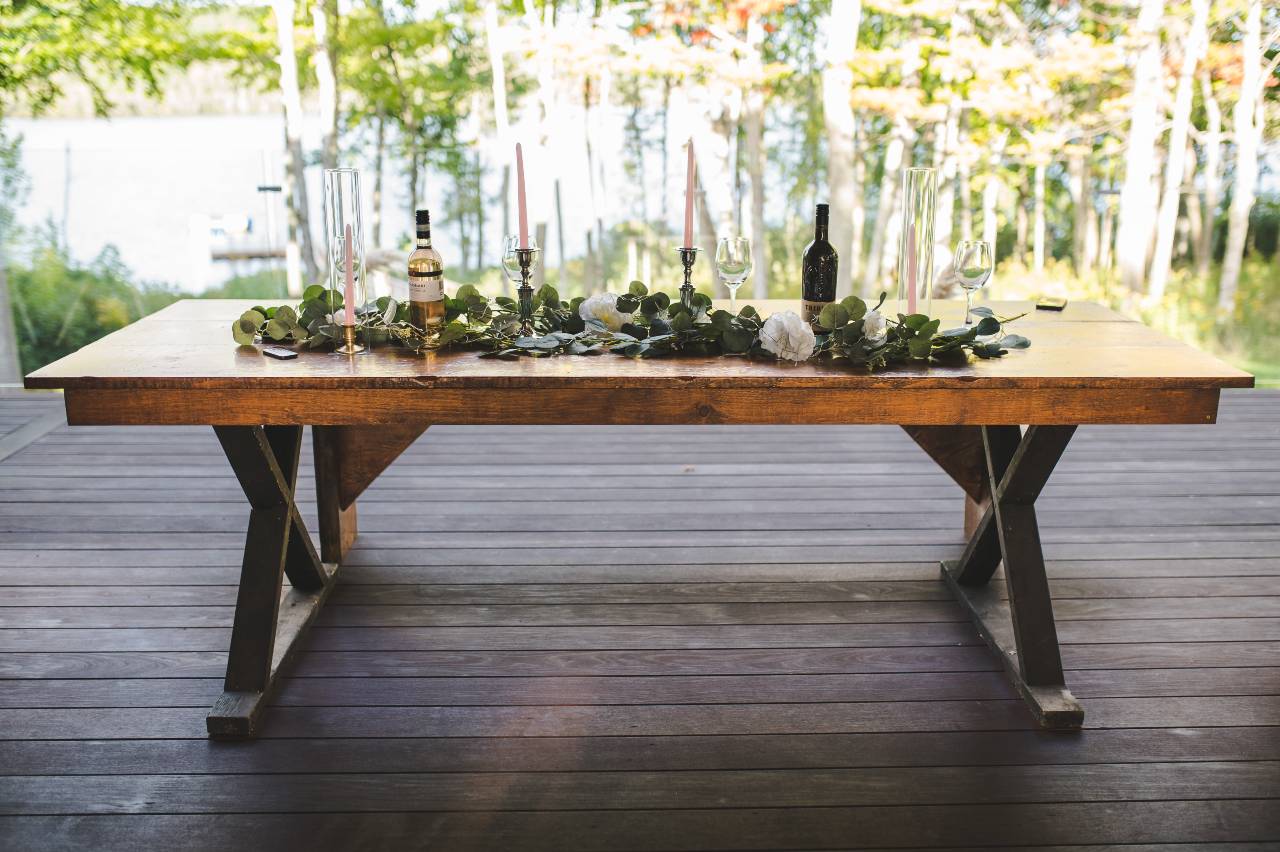
If harvest tables keep showing up on your wedding Pinterest board and you’re not entirely sure why, you’re not alone. Couples land on them through inspiration photos, through venue recommendations, through friends who had them at their own weddings and haven’t stopped talking about them since. The visual is immediately appealing: long, warm wood, gathered people, a reception that looks less like a catered event and more like a really beautiful dinner party.
But Pinterest doesn’t tell you whether they’re actually the right choice for your wedding, and that’s a more practical question worth answering before you commit.
The short answer is yes, harvest tables are genuinely excellent for wedding receptions. The longer answer is that they work especially well in specific contexts, one of which is an outdoor Muskoka wedding. Here’s the full picture.
What a Harvest Table Actually Is
This sounds obvious but it’s worth clarifying because the term gets used loosely. A harvest table is a long, rectangular, solid wood dining table, typically anywhere from 6 to 12 feet in length, designed to seat guests on both sides along the length of the table. The name comes from the tradition of communal harvest feasts, where farm families and their workers would gather at long tables to share a meal after bringing in the crops.
The modern wedding harvest table carries that same energy forward: long, communal, everyone oriented toward each other. In the wedding context, they’re almost always made from solid wood, either in a standard plank construction or in a live-edge style where the natural edge of the wood is preserved and visible. Both look beautiful in outdoor settings. The live-edge version adds a layer of visual interest and a more distinctly artisan quality.
What they are not is a banquet table with a tablecloth thrown over it. A proper harvest table is a standalone piece of furniture with enough visual weight and character to be the centrepiece of a reception space without any additional dressing. That distinction matters for outdoor weddings specifically, where the table itself is a design element, not just a surface.
The Social Dynamic Difference
This is the reason harvest tables keep winning over round tables for couples who think carefully about the guest experience they want to create.
At a round table, you’re in a conversation cluster. You can comfortably talk to the three or four people immediately adjacent to you, and the person directly across the table if it isn’t too wide. The couple at your table who you’ve never met? You might exchange pleasantries at the start of the evening and not much else. The dynamic is intimate within a small group and relatively isolated from the rest of the room.
At a harvest table, the dynamic is completely different. The linear seating means conversations travel along the table rather than circling within a fixed group. You’re not just talking to the people immediately beside you. You’re within easy conversational range of a much longer stretch of guests. Someone three seats away catches your eye, says something funny, and suddenly you’re all laughing together. That cross-seat connection is what makes harvest table receptions feel more alive.
For couples who want their guests to actually meet each other and leave the reception having made new connections, the harvest table format does that work that round tables simply don’t. This is especially true for Muskoka weddings where guests have often driven two or more hours to be there and are already in a holiday mindset that makes them more open to conversation. The setting does half the work of breaking down social barriers, and the harvest table does the other half.
There’s also a visual dimension worth mentioning. When you look down the length of a harvest table during dinner and see faces, candlelight, flowers, and laughter all the way to the end, that image is what makes a reception feel like a celebration rather than a meal. It photographs extraordinarily well, and it’s the kind of scene that lives in people’s memories long after the evening is over.
Did You Know? Research on dining and social behaviour consistently shows that communal, long-table seating produces more cross-group interaction than round table seating of equivalent size. The linear format removes the psychological barrier of a closed circle and makes it easier for guests to engage with people they don’t already know.
How They Work Outdoors
Harvest tables were made for outdoor use, and this is where the distinction between a well-built solid wood table and a less substantial alternative becomes most relevant.
Outdoors, tables face conditions that indoor furniture doesn’t. Direct sun, morning dew, the temperature swing between afternoon ceremony and late-evening reception, wind, and the uneven terrain that characterizes most Muskoka cottage properties. A table that isn’t built from properly finished solid wood will show the effects of those conditions quickly, either in the finish, the stability, or the structural integrity of the piece.
A well-built solid wood harvest table handles all of that. The weight of the table keeps it stable on grass even when there’s a breeze off the lake. The solid construction doesn’t shift or flex the way lighter tables do when guests lean on it, rest their elbows, or move dishes around during dinner. The finish, when properly applied and maintained, resists moisture and holds its appearance through a full outdoor reception evening.
What this means practically is that you can seat guests at a harvest table for a three-course dinner with wine service on a Muskoka lakeside property in July and the table is going to perform exactly the way a dining table should. It’s not going to wobble. It’s not going to absorb moisture from the evening air and start feeling soft. It’s not going to look different in the 9 p.m. photos than it did in the 6 p.m. ones. That reliability is what makes solid wood harvest tables the right choice for outdoor events specifically.
Insider Tip from Craig: One of the most underrated benefits of a solid wood harvest table outdoors is that it doesn’t need linens. In a Muskoka outdoor setting, a bare wood table with natural centrepieces looks completely at home and genuinely beautiful. You eliminate a whole category of rental cost and styling complexity, and the table looks better for it. A white tablecloth in front of a Muskoka lake view is a missed opportunity.
Standard vs. Live Edge: Which One Is Right for Your Wedding
Both work beautifully at outdoor weddings. The choice comes down to the aesthetic you’re going for and how much visual presence you want the table itself to have.
Standard harvest tables have clean, straight edges and a consistent plank surface. They’re elegant without being statement pieces, which means they work with a wide range of wedding aesthetics, from classically rustic to more polished and refined. If your floral and decor choices are doing a lot of the visual work, a standard table gives them room to shine without competing.
Live-edge harvest tables have an irregular, natural edge that follows the original shape of the wood. No two are identical. The grain, the colour variation, the edge profile are all specific to the individual tree the wood came from. A live-edge table is a visual statement on its own, and it needs less styling to look interesting because the table itself is inherently interesting. For couples who love the idea of a centrepiece that’s genuinely one-of-a-kind and deeply connected to the natural materials of Muskoka, live edge is the direction.
A few questions worth asking yourself when deciding:
- Is my overall aesthetic more polished or more raw and natural? Standard leans toward the former, live edge toward the latter.
- How much of the table surface will be visible during the reception? Heavy centrepiece styling obscures the live edge, which somewhat defeats the purpose.
- Do I want the table to be a focal point or a supporting element? Live-edge tables want to be noticed. Standard tables are content to support the scene.
Sizing and Quantities
Getting the sizing right matters more than most couples realize, and it’s worth working through the numbers before you assume you know what you need.
A standard harvest table seats approximately 8 to 10 guests comfortably, depending on the length of the table and how you configure the head positions. For a reception with 80 guests, that means roughly 8 to 10 tables, depending on whether you include a separate head table or sweetheart table for the couple.
The spacing between tables outdoors needs to be more generous than indoors. Guests are pulling out chairs or benches on uneven ground, servers are moving between tables with food and drinks, and the general flow of an outdoor reception requires more room than the same configuration would need inside a tented or indoor venue. A minimum of 5 feet between tables is a reasonable starting point. More is better if the property allows it.
The length of your overall table arrangement also affects how the reception space feels. A series of shorter tables scattered through a space creates a different atmosphere than two or three long tables running the length of the property. For intimate Muskoka weddings with a tighter guest count, one or two long harvest tables running end to end creates an extraordinarily connected and beautiful reception setup. For larger guest counts, multiple parallel tables work well with the right spacing.
How They Pair With Bench Seating
This combination, harvest tables with bench seating, is the defining visual of a Muskoka outdoor reception, and it works for reasons that go beyond aesthetics.
Benches along harvest tables keep the material language consistent throughout the reception. The same wood tones, the same natural texture, the same design philosophy that made the ceremony beautiful carries through into the reception. The visual through-line from the ceremony benches to the reception tables and seating is something guests feel even when they can’t articulate it. The whole event reads as designed rather than assembled from separate decisions.
Benches along a harvest table also encourage guests to slide in and out easily, which keeps the energy at the table more fluid during dinner. Chairs create a more fixed, individual seating arrangement. Benches are more communal, which reinforces the harvest table’s natural social dynamic.
At Wedding Benches of Muskoka, we charge by the event rather than by the day, which means the ceremony benches and reception benches are covered under the same rental fee. Couples who use benches for both the ceremony and the reception get a fully cohesive furniture setup without paying twice for the same pieces.
What to Ask Your Rental Company Before Booking
Not all harvest tables are the same, and a few specific questions are worth asking before committing to a particular company:
- Is the table solid wood or a veneer over a lighter core? Solid wood handles outdoor conditions, temperature changes, and sustained weight in ways that veneered or composite alternatives don’t.
- What finish is on the table and how is it maintained between events? A table that goes out to 20 weddings a season without refinishing will show it.
- What are the exact table dimensions and how many guests does each seat? Get specific numbers, not a general range.
- Does the rental include delivery, setup, and pickup? A table that arrives the morning of your wedding and requires you to position it on uneven terrain is a very different product than one that arrives two days early and is already in place.
- Have they set up at your venue before? A company that knows your property already knows where the level sections are, how wide the access road is, and what the terrain looks like between the parking area and the reception site.
At Wedding Benches of Muskoka, our harvest tables are solid wood, finished and maintained regularly, and delivered with full setup included one to two days before your wedding.
If harvest tables are on your radar and you want to talk through sizing, configuration, and what works best at your specific venue, reach out through the contact page at weddingbenchesofmuskoka.ca. We’re happy to walk you through the options.